Lap Cat Services
Editing
Lap Cat Editing offers structural editing, stylistic editing, copy editing, and proofreading services for
- businesses (of all sizes)
- non-profit organizations
- government
- self-published authors.
I work with content destined for both online and print publication, including books, reports, correspondence, blogs, websites, social media, marketing materials, educational materials, presentations, instruction manuals, and more.
I also offer comparative and stylistic editing for French to English and English to French translations, confirming that the translated text is faithful to the original and that it flows well in the target language.
Writing
No time to pull together that first draft? Let me help you with that! While editing and writing are two different skill sets, my editing skills build on a lifelong relationship with writing and language, including 20 years of writing for the federal government and my own small business.
In addition to editing, I offer writing services for businesses and organizations that lack the time or capacity to draft web content, reports, marketing materials, standard operating procedures, and other strategic documents that are important to your success.
Subject matter expertise
While your editor or writer doesn't have to be an expert in your field, it can be helpful if they are familiar with your subject matter.
Given my professional background in economic development, political science, and entrepreneurship, and an even broader range of personal interests, there isn’t much I haven’t dabbled in. And even if I am not familiar with your topic, I welcome the opportunity to learn new things.
That said, there are a few areas that I am particularly passionate (and knowledgeable) about. If you have a project that touches on environmental sustainability, social justice, or local economic development, I am all ears!
Not sure if I have the expertise to work on your project? Please ask!
A note to self-published authors: While my experience with editing fiction is limited, it is an area that I am actively looking to grow into. You can read the feedback from my first middle grade fiction project in the testimonials. If you are looking for a gentle but professional editor who will help you get your story across the finish line, I would love to hear from you!
The stages of editing
In the simplest terms, editing is a fancy word for revision. And revision is a very important, but often-overlooked, part of the writing process. Very rarely do it we get it right in our first draft!
Like writing, editing is most effective when undertaken in stages. There are four basic stages of editing:
- Structural (or developmental) editing
- Stylistic (or line) editing
- Copy editing
- Proofreading
With the exception of structural editing, which looks at the overall organization and content of a manuscript early in the drafting process, most editing happens after the author has finished working on the manuscript themself.
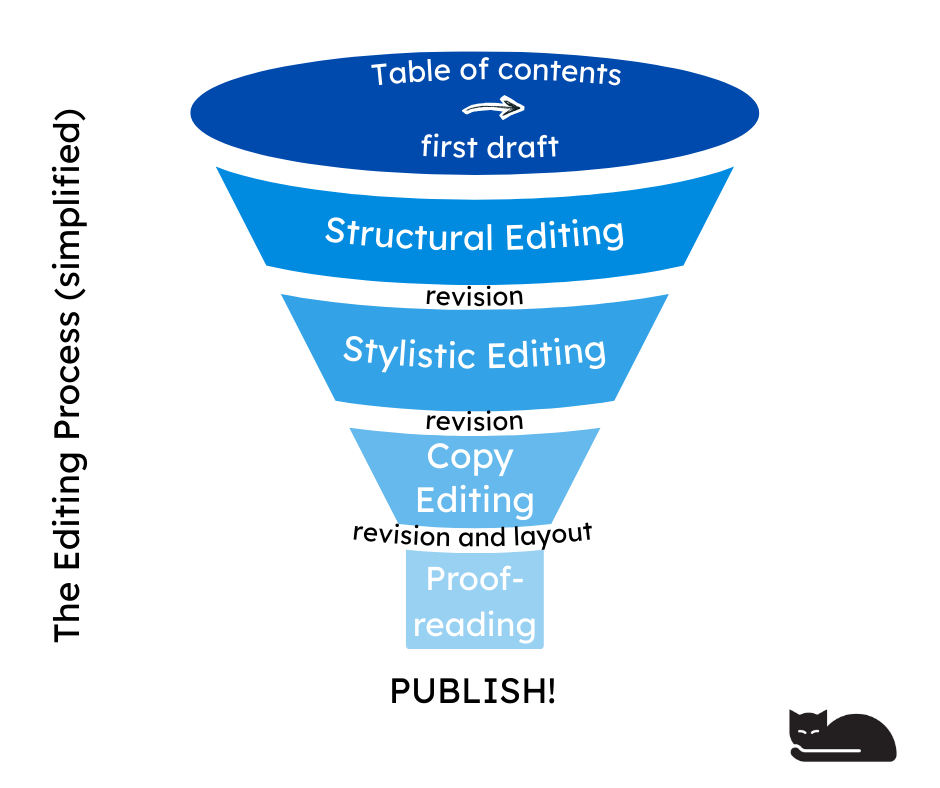
These editing stages don’t always happen in isolation, but they illustrate the different levels of revision required to prepare a manuscript for publication or presentation to its intended audience. Each stage of editing considers different elements of the manuscript, from the suitability of content to the placement of commas, all with the goal of ensuring that the final product meets the audience's expectations, is appropriate for the chosen medium, and is effective in achieving the author's goal.
While you don’t have to become an expert in the terminology, understanding the different stages of editing can help you plan appropriately for revision time. It can also help you better explain to your editor what you want them to do and, in turn, understand what they are committing to.
Structural editing seeks to optimize two things: organization and content.
This is the first stage of revision, and it usually takes place early in the drafting process, before you start refining language or debating comma placement.
At this stage, the editor may
- reorganize content to improve the logical flow of ideas;
- suggest additions or deletions to meet length requirements or to better align with audience needs;
- recommend headings to help the reader navigate the material;
- help create or secure appropriate visuals and recommend where to place them;
- point out areas of questionable accuracy, imbalanced content, or inadequate ;
- recommend areas where content would be better presented as a table, list, or infographic;
- identify any required permissions.
Structural editors can even provide feedback on the completeness and organization of your table of contents before you start drafting the content itself.
If you are interested in applying plain language principles to your document, now is a great time to start. A structural editor can help ensure that
- the document contains the information your readers need;
- the content is structured in a way that makes sense to them;
- navigational aids make it easy for them to find what they are looking for.
Think about structural editing as big-picture editing. While it is tempting to dive into fixing grammar and spelling mistakes right away, you risk wasting your precious time and money if you focus on perfecting content that might yet get chopped or rearranged.
Stylistic editing is usually the first stage of editing after the author has completed a substantive draft. It focuses on clarifying meaning, improving flow, and refining the language to ensure it is appropriate for the intended audience and format, and that it effectively supports the author’s goals.
Suggested edits at this stage could include
- eliminating clichés, euphemisms, and jargon that could weaken your argument or confuse the reader;
- applying plain language principles;
- ensuring a consistent and appropriate tone and level of formality;
- smoothing transitions;
- restructuring sentences and paragraphs to improve logic and flow; and
- eliminating redundancies and empty phrases.
While I will typically correct any grammar and spelling errors that I see at this stage, it is still not my focus. Although stylistic and copy editing are frequently combined into one round of editing (often called line editing), correcting spelling and grammar errors before the text is finalized can create extra work—and extra cost.
Copy editing
Copy editing is the last round of revision before the text gets laid out for publication, whether that be as a web page, a brochure, a book, or a PDF report.
It involves what most people imagine when they think about editing—going over the manuscript with a fine-tooth comb to correct any errors in grammar, spelling, punctuation, and usage (e.g., are you pouring over the pages while the rain pores down outside?).
It also involves checking for
- consistency of terminology and style (headings, formatted lists, etc.);
- the accuracy of information; and
- the completeness of the content—identifying missing web links, captions, citations, etc.
If the manuscript includes tables, figures, or references, the copy editor will usually review these too.
When editing fiction, a copy editor will also check for the consistency and continuity of characters, timelines, and plot, ensuring that Barbara’s hair colour didn’t change halfway through the story or that critical plot elements weren’t lost when chapters were cut to reduce word count.
Ideally, copy editing happens when the manuscript is more or less finalized. However, if a separate round of stylistic editing hasn’t been done beforehand, it is common to include some more stylistic edits at this stage, all with the goal of getting the manuscript ready for layout and publication.
If a style sheet hasn’t already been created for your project, I will create one here. The style sheet is an important tool for ensuring consistency throughout your document. It identifies the dictionary and style guide (e.g., The Chicago Manual of Style) that your manuscript should adhere to, as well as decisions that your or I have made about, for example, the use of serial commas, how to express numbers and dates, spacing around dashes, the use of bold or italics for emphasis, heading formats, abbreviations, and the spelling and use of names or important vocabulary.
Proofreading
Proofreading happens after the manuscript has been laid out in its final design, ready for publication. At this point, the text should be finalized and all the headings, graphics, captions, headers and footers, and references should be in place.
Proofreading focuses on two things:
- catching any outstanding errors that got missed in previous rounds of editing, and
- identifying any new errors that were introduced during the layout stage.
Both of these scenarios are common, which is why proofreading is an important stage of editing—even if you feel like your manuscript has already been edited to death.
Proofreading is the last stage of editing. I emphasize last because it should not be the only editing you do. The design or layout phase can be expensive and time consuming, and any changes you make after the layout is complete will add to your cost. This is not the time to be rearranging paragraphs or applying plain language principles.
A good proofreader will weigh the cost of fixing any issues they find against the consequences of letting them stand. They will also recommend solutions that have the least possible impact on the design, although issues like missing text will inevitably require some reorganization.

Still not sure what you need?
Please reach out and tell me about your project. I'll help you figure it out!